
 685 738 325
Preventive Medicine
Internal and external parasite prevention in dogs and cats: complete guide
18 June 2026 · Updated on 24 August 2026

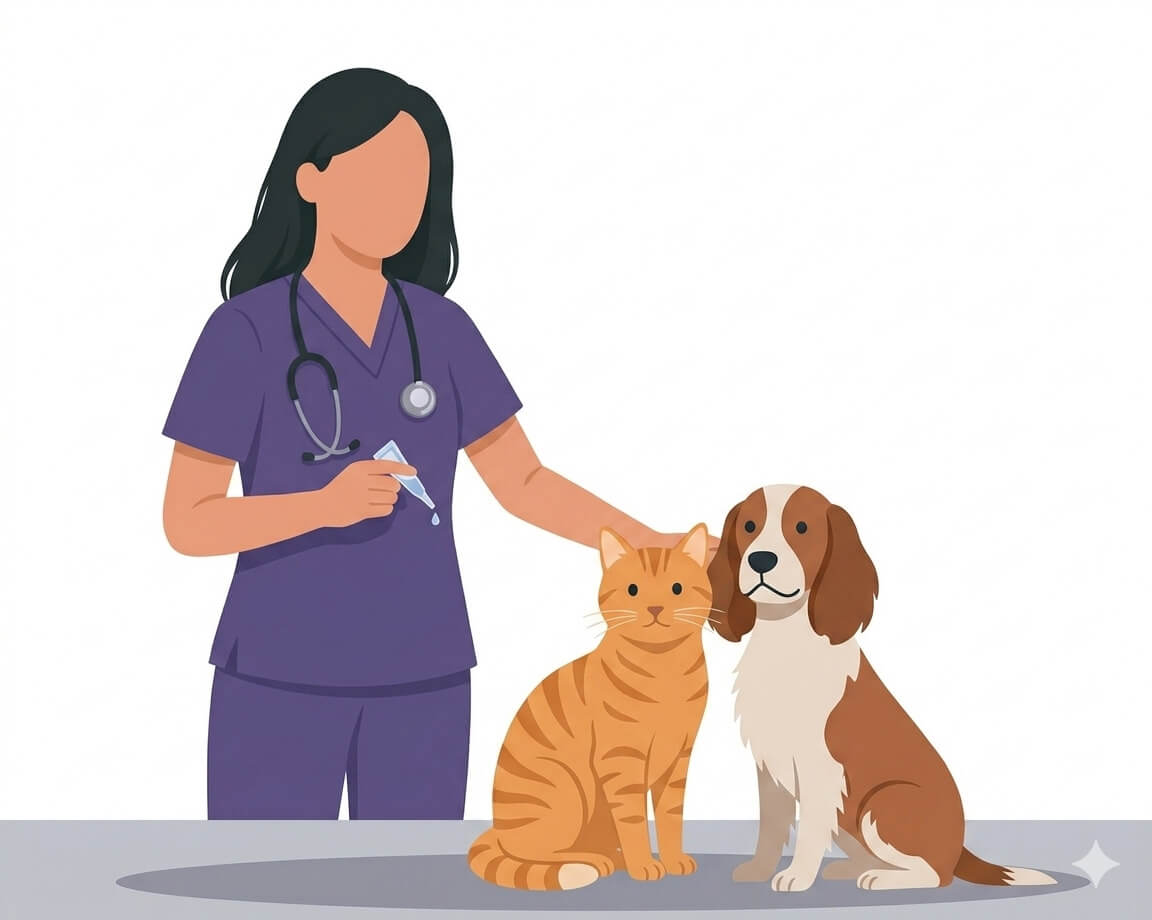
Alongside the vaccination schedule, parasite prevention in dogs and cats is the second fundamental pillar of veterinary preventive medicine. And yet it’s the one most often overlooked.
The reason is straightforward: the vast majority of parasites are invisible during the early stages of infestation. An apparently healthy dog or cat can be harbouring unwanted guests without showing the slightest symptom, while simultaneously acting as a source of contagion for other animals or for the people around them.
In urban environments like Barcelona, the biological cycles of these organisms remain active throughout the year. Protecting your pet properly isn’t about a one-off product — it’s about a plan built with sound judgement and consistency.
Internal vs. external: two different fronts
Complete protection requires covering both fronts at once. They are not interchangeable: each addresses a different type of threat.
Internal parasite prevention
This targets organisms that live inside the animal’s body, primarily in the gastrointestinal tract, though some species can migrate to the lungs or heart. The main ones are:
- Roundworms (nematodes): feed on the animal’s nutrients or blood
- Tapeworms (cestodes): segmented parasites that lodge in the intestine
- Unicellular protozoa: such as Giardia or Toxoplasma
The added risk is zoonosis: some of these intestinal worms can be transmitted to people, making prevention a matter of household public health.
External parasite prevention
This is designed to control arthropods that live on or feed from the animal’s skin and coat: fleas, ticks, mites and lice. Beyond the obvious discomfort and itching, their real danger lies in acting as vectors for serious infectious diseases, injecting bacteria, viruses or parasites directly into the bloodstream.
Signs that may indicate an infestation
Knowing the most common warning signs helps you react in time. That said, we always stress that the absence of signs does not guarantee the animal is parasite-free.
| Type of parasite | What you may notice at home |
|---|---|
| Internal parasites | Recurring vomiting, diarrhoea (sometimes with blood or mucus), progressive weight loss despite a normal appetite, dull coat, anal itching (the animal scoots along the floor), bloated belly (especially noticeable in puppies and kittens). |
| External parasites | Compulsive scratching, biting at specific areas of the body, localised hair loss, skin redness, small black specks in the coat (flea droppings), or ticks visibly attached to the skin. |
Parasite prevention schedule: puppies and kittens
The first weeks of life are the period of greatest vulnerability. The immune system is still developing, and a heavy infestation can trigger severe anaemia, malnutrition or intestinal blockages.
As a general guide:
- Internal deworming typically begins between 2 and 3 weeks of age, before weaning
- Mothers can transmit parasites through the placenta or milk, so a systematic monthly treatment is standard
- This monthly rhythm continues until the puppy or kitten reaches approximately 6 months of age, at which point the transition to an adult schedule is assessed individually
Parasite prevention schedule: adult dogs and cats
Once basic development is complete, prevention needs change but don’t disappear. Modern veterinary practice doesn’t apply a one-size-fits-all formula: it requires assessing each animal’s individual risk profile.
Periodic internal deworming
Frequency varies considerably depending on lifestyle. A dog that visits dog parks daily, interacts with multiple other dogs, or tends to eat things off the ground will need more frequent treatment than a cat that lives exclusively indoors. The vet determines the right frequency for each case.
Continuous external protection
In our region, the pressure from external parasites is constant throughout the year. Barcelona’s mild temperatures mean there’s no safe season to let your guard down. Protection must be uninterrupted, combining different products according to their duration.
Key differences between dogs and cats
The biology, physiology and behaviour of each species require very different strategies. Assuming that what works for one works for the other is one of the most frequent — and dangerous — mistakes in home pet care.
Indoor cats are still at risk
Even with lower environmental exposure, the risk never reaches zero. Owners themselves can unwittingly act as mechanical vectors, carrying parasite eggs or fleas on clothing, bags or shoe soles picked up in public spaces.
Product format matters
While dogs tolerate a wide range of antiparasitic collars well, cats are usually treated with a spot-on pipette applied to the back of the neck. This reduces the risk of accidental snagging during jumps and lowers the chance of the animal ingesting the active ingredient while grooming.
External parasite prevention and leishmaniasis: a key connection
In the Mediterranean region, the choice of external antiparasitic goes well beyond avoiding fleas or the unpleasant find of a tick. Certain advanced veterinary products — some prescription spot-ons and specific collars — don’t just kill parasites on contact: they also incorporate a powerful repellent effect against the sandfly.
The sandfly is the insect that transmits leishmaniasis, a chronic and systemic disease that affects dogs in our region seriously. As we explain in detail in our complete guide to leishmaniasis in dogs, protection against this insect is one of the most important preventive tools available in Barcelona.
What you need to know:
- Not all external antiparasitics protect against the sandfly. Many conventional collars and standard spot-ons are excellent against fleas and ticks, but have no repellent effect against this insect.
- The specific product choice should be made with technical guidance, checking the specifications with your vet team.
- Assuming any format covers all threats is a common mistake with real consequences.
Why at Rovira we include parasite assessment in every check-up
Every pet that comes through our door in Gràcia has its own routines, age and home environment. That’s why assessing parasite status and updating preventive protocols is a non-negotiable part of every routine appointment.
By linking this closely to the vaccination schedule for dogs and cats, we build a coherent protection system:
- Vaccines prepare the immune system against viral and bacterial infections
- Parasite prevention protocols remove the organic stress caused by parasites and allow that immunity to work properly
We also keep a digital record of every treatment, reminding you when it’s time to renew the spot-on, change the collar or give the internal tablet — preventing those dangerous “uncovered windows” when a simple lapse in routine leaves your pet exposed.
Frequently asked questions
— Can I deworm my pet myself at home?
Yes, you can administer the product — tablet or spot-on pipette — at home without difficulty. What a professional needs to determine is the right active ingredient, the exact dose based on your pet’s current weight, and the treatment frequency. This is especially critical for growing puppies and kittens, pregnant or nursing females, and animals with chronic conditions.
— Does my indoor cat that never goes outside need parasite treatment?
Absolutely yes. Its risk profile is lower than that of a cat with outdoor access, but it never reaches zero. Parasites can reach the home through the owners themselves, visiting animals, or insects coming in through windows. The schedule can be more spaced out, but should never be dropped entirely.
— Can I use the same product for internal and external parasites?
Some advanced combination products (usually spot-on or oral tablet form) cover certain internal and external parasites simultaneously. But not all products on the market are broad-spectrum. Always check the specific ingredients with your vet, and never assume a particular format automatically covers both types of protection.
Keeping your companion’s parasite prevention up to date is an act of responsibility that directly affects the health of your whole household. If you’d like to review your pet’s current protocol, check whether the product you’re using at home is right for their current weight and lifestyle, or design a preventive schedule from scratch for a new family member, the team at Rovira Veterinary Clinic in Gràcia is here to help. Contact us to book a full check-up.
Sources
Do you have any questions about your pet?
Book an appointment